Blog Post contributed by Pam LaFountain
Recently, Nancy Pollard (of the Pollard’s Mills family) and her sister Cindy Rand visited the Newport Historical Society Museum laden with bags and books of family genealogy, photos and other historical artifacts. Among the many items was a small envelope which may have gone unnoticed if not for the fact that inside were postcards with pictures of Thanksgiving. It being only a few days from the holiday; one that Newporters take much pride in claiming a major piece of its history, due to the role of native Sarah Buell Hale in convincing Abraham Lincoln to proclaim Thanksgiving a federal holiday, the postcards drew my attention. So, with questions swarming around in my head, I decided to see if there was any history to these little postcards.
The first American picture postcard was designed in 1873. By the early 1900s, Thanksgiving was one of the most popular holidays to send postcards across town or across the country. The era from 1905-1915 became known as the “Golden Age of Postcards.” These messages could be sent to family and friends for only a penny, much cheaper than the folded card of the time. This was also before the telephone was widely used in private homes. The standard postcard was 3.5” x 5.5.”
Tens of millions of postcards were sent during its “Golden Age.” General stores, print shops, drug stores, or any store that sold paper goods, sold Thanksgiving postcards.
Most of the pictures on the front of these Thanksgiving postcards were lithographed. Simply said, this process involved the artist drawing on a flat stone surface, using grease, water and ink. The principle of “oil and water don’t mix” applied to this process. Some of these postcards were later produced by commercial printers.
Today these Thanksgiving postcards are widely popular as historical items. Their topics of tradition, humor, gratitude, family togetherness and patriotism make them desirable by deltiologists, (postcard collectors), especially by those who value the history of the topics on the cards. Thanksgiving postcards also reflect the technology, values and artistic style of the time period.
So, what about the Pollard postcards? Here is a little history about each.
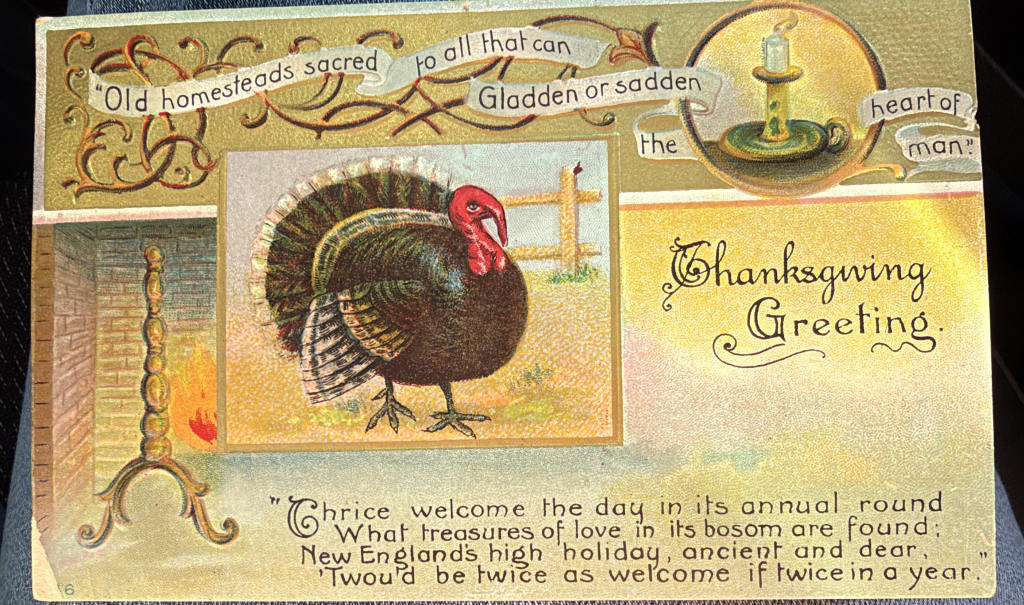
Postcard #1 Dated 11/23/1910 – from Ada Tenney to Clara Tenney. The candlestick, banner and andiron are embossed (stamped so it stands out above the rest of the card). The back of the card features a divided address style, (one side for the address, the other for a message) and a one cent stamp is still present. Also because this postcard was only going to another person in the same small rural town, the address is simply “Town.” Using this address was common for the time period.
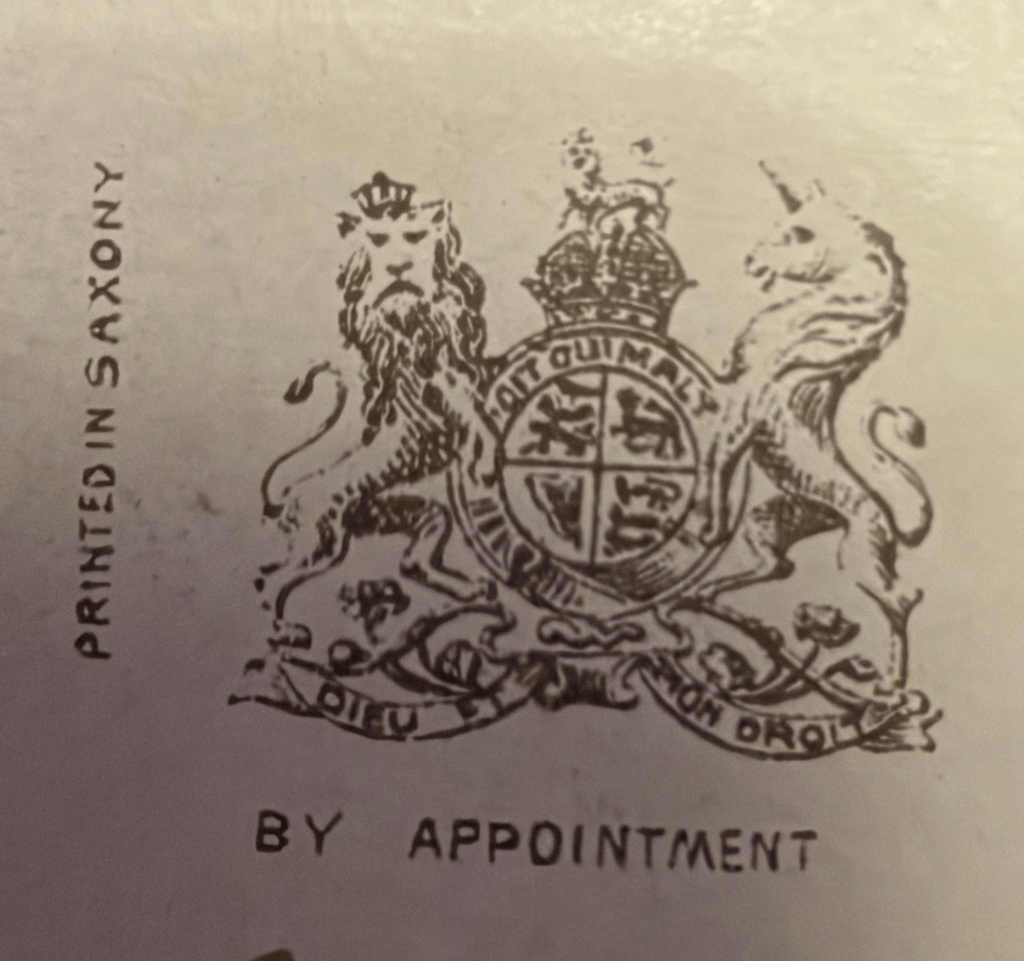
Postcard #2 – Dated November 25, 1907 from Boston Massachusetts, from Susie to Mrs. S.A. Tenney. This postcard would be most desirable among collectors. It was produced by Rapheal Tuck & Sons, a printing firm in London, England that operated from 1866-1959. The firm also had locations in Paris, Berlin, Montreal and NYC. Raphael’s son, Adolph Tuck created their first picture postcard. The Tucks were considered “Art publishers to their majesties the king and queen” according to the back side of the card. This title was given to them by Queen Victoria who granted the Tucks the Royal Warrant of Appointments in 1883.
The back side also includes the Royal Coat of Arms of the United Kingdom. This recognition is given to companies or individuals who provide goods or services to the royal family.
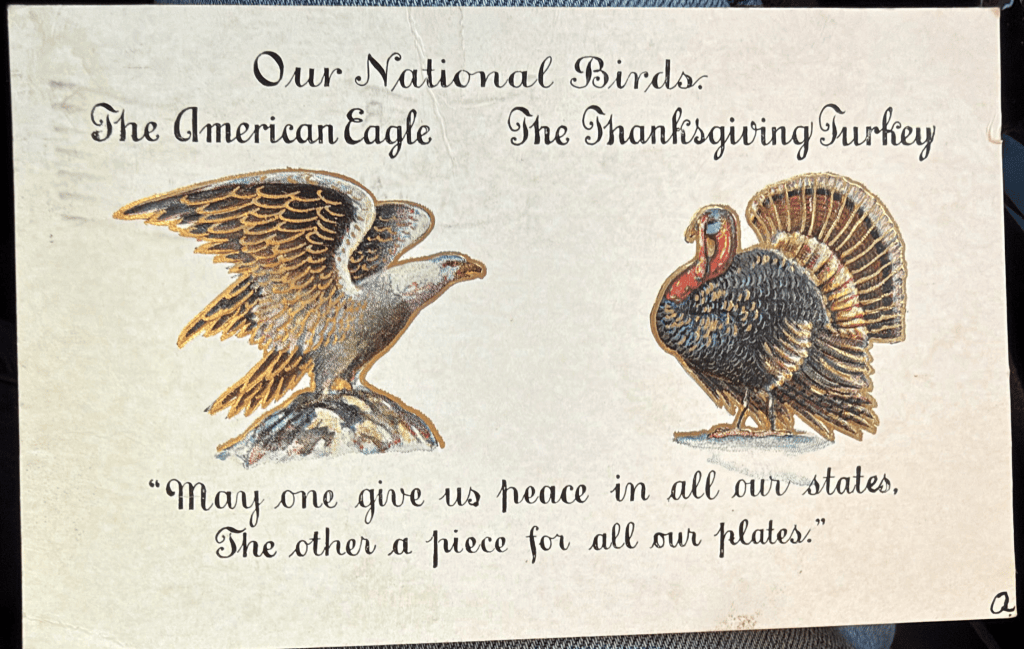
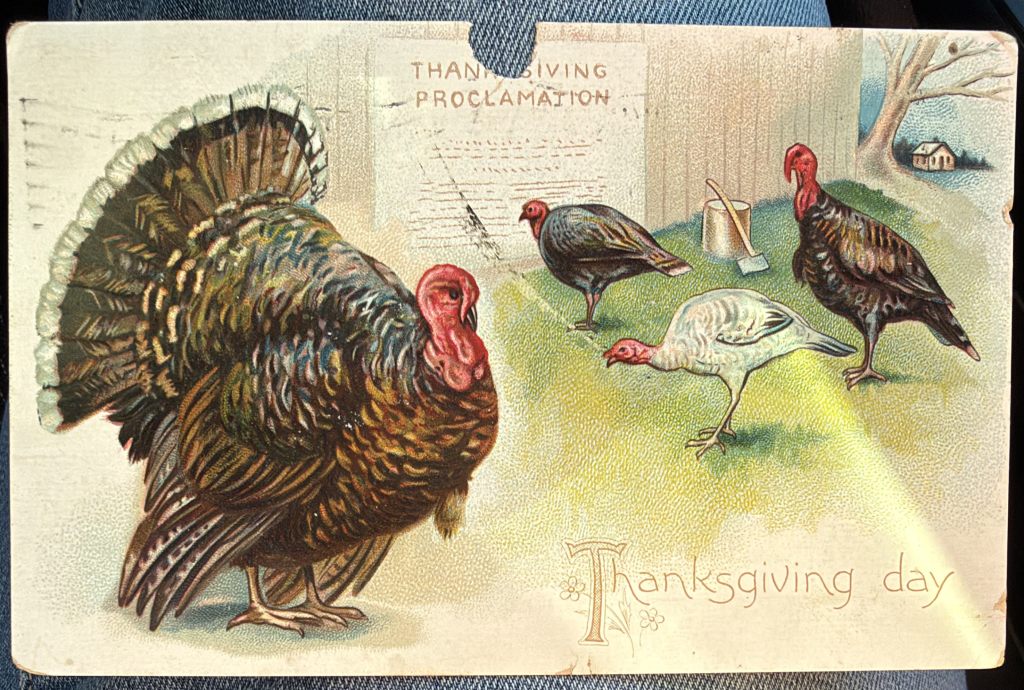
Post Card #3 – Dated November 27, 1906 from Boston, Massachusetts, to Clara Tenney from S.R.S. This card is an example of the spirit of patriotism that was common on many of the Thanksgiving postcards. The backside features a single address section, no separation for address & message. The eagle and turkey are embossed on this card.
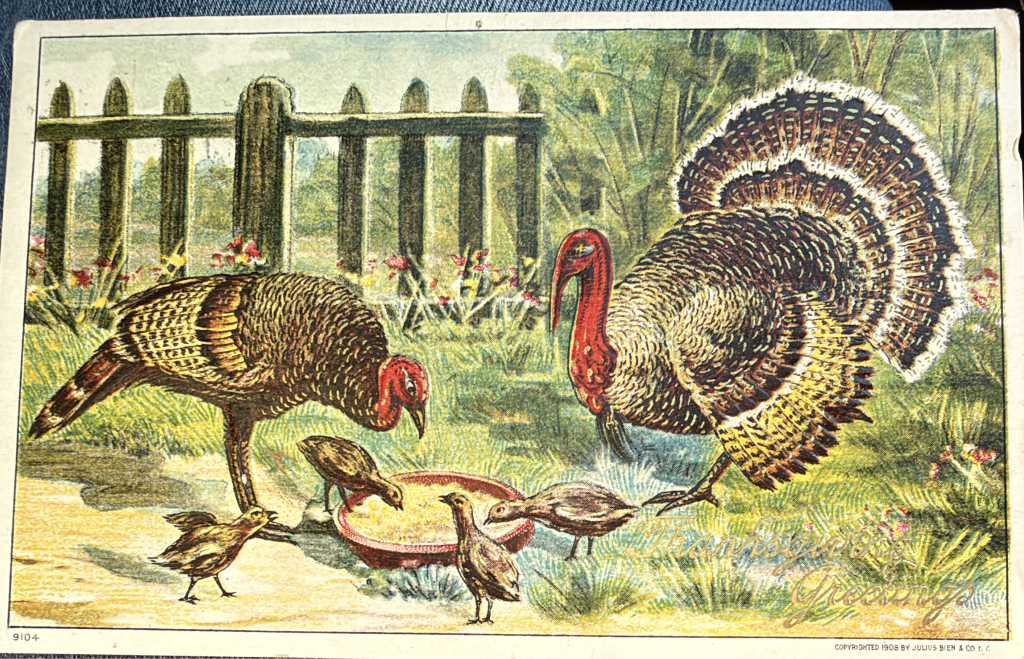
Postcard #4 – Dated November 23, 1910, from Charlotte to Clara Tenney, mailed from Stoneham, Massachusetts. This Thanksgiving postcard was published by Julius Bien & Co. from NYC, This company was known for their chromolithographic holiday cards featuring turkeys. In this process which follows the lithographic style described above, but includes using a different flat stone for each color in the print. The card is embossed, with gilded writing and is listed as a part of a Thanksgiving series of postcards, # 910.
The Newport Historical Society would like to thank Nancy Pollard and Cindy Rand for donating these items to our collection. Remember, if you have an item that has a connection to Newport’s history, we would love to add it to our collection. And, if you enjoyed this story, please consider joining the Newport Historical Society, so that we can continue to archive our collection and enhance our ability to share this rich history with you and your family. Visit our Membership Page https://newportnhhistory.org/membership/
Blog Post contributed by Pam LaFountain
Sources:
- Celebrating traditions through vintage Thanksgiving postcards – Queens Ledger
- A Grateful Gallery of Thanksgiving Postcards
- Historic Thanksgiving Postcards Spotlight Festive Traditions
- “Stocking the Store for Thanksgiving” – Commercial Order (1907) – History In The Mail | Postcards and Historic Papers
- The Technology and Treatment of an Embossed, Chromolithographic ‘Mechanical’ Victorian Valentine Card
- Family Treasures of Nancy Pollard and Cindy Rand
Discover more from Newport, NH Historical Society
Subscribe to get the latest posts sent to your email.
Thank you very much Mike. Your story was so interesting and the depth of research you conducted to add context to all of those postcards is amazing. For a \”Non-belonger\” It adds immensely to my acquired knowledge about the town I now live in. Thank you and Happy Thanksgiving. Linda
Hi Linda. I can’t take credit for this story. It was written by Pam LaFountain. Pam did the research and forwarded the story to me to post on the website. I agree that Pam does an amazing job with her research. Happy Thanksgiving! Mike